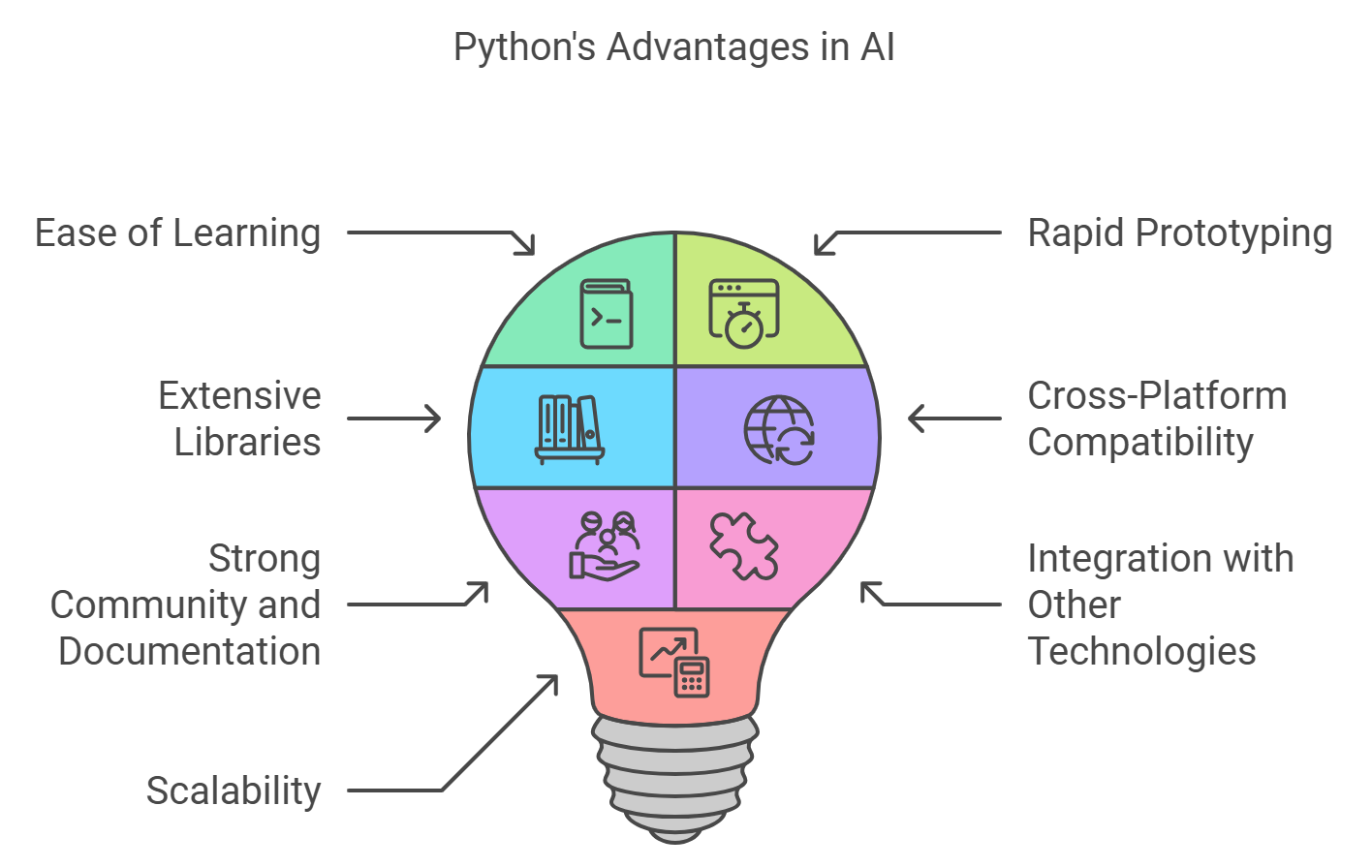
Python for AI: The Language of Choice
In the realm of artificial intelligence (AI), Python has emerged as the go-to programming language for developers and researchers worldwide. Its simplicity, versatility, and robust community support make it an ideal choice for both beginners and seasoned professionals in AI development. This article explores why Python is so popular in the field of AI and highlights some of its key features and libraries.
Why Python?
Python’s popularity in AI can be attributed to several factors:
- Ease of Learning: Python’s syntax is clear and concise, making it easier to learn compared to other programming languages. This simplicity allows developers to focus more on solving complex AI problems rather than getting bogged down by intricate code.
- Extensive Libraries: Python boasts a rich ecosystem of libraries tailored for AI development. Libraries such as NumPy, Pandas, and Matplotlib provide essential tools for data manipulation and visualization, while TensorFlow, Keras, and PyTorch are powerful frameworks for building machine learning models.
- Community Support: A vibrant community means there’s a wealth of resources available online. From forums to tutorials and documentation, developers can easily find solutions to their problems or learn new techniques.
- Integration Capabilities: Python can seamlessly integrate with other languages like C++ or Java, allowing developers to optimize performance-critical parts of their applications when necessary.
Key Libraries for AI Development
The following are some essential Python libraries that have become staples in the AI toolkit:
NumPy
A fundamental package for scientific computing with Python. It supports large multidimensional arrays and matrices along with a collection of mathematical functions to operate on these arrays.
Pandas
This library provides data structures and functions needed for efficient manipulation and analysis of structured data. It’s particularly useful for handling large datasets commonly encountered in machine learning projects.
TensorFlow
An open-source framework developed by Google Brain that facilitates building deep learning models. TensorFlow’s flexibility allows users to deploy computation across multiple CPUs or GPUs seamlessly.
Keras
A high-level neural networks API written in Python that runs on top of TensorFlow or Theano. Keras simplifies the process of designing complex neural network architectures with minimal code.
PyTorch
A dynamic computational graph framework favored by researchers due to its flexibility and speed during model training processes. Developed by Facebook’s AI Research lab (FAIR), PyTorch has gained significant traction among academic circles.
The Future of Python in AI
The future looks bright for Python as its role within artificial intelligence continues expanding rapidly across various industries—from healthcare diagnostics powered by deep learning algorithms all the way through autonomous vehicles navigating our roads safely using computer vision technologies built upon this versatile language platform!
In conclusion, whether you’re just starting your journey into artificial intelligence or looking at advancing your skillset further—learning how harness power behind python will undoubtedly prove invaluable asset throughout career endeavors!
7 Essential Python Tips for Enhancing Your AI Skills
- Use libraries like NumPy and Pandas for efficient data manipulation.
- Utilize scikit-learn for implementing machine learning algorithms easily.
- Learn about neural networks and deep learning using frameworks like TensorFlow or PyTorch.
- Understand the importance of data preprocessing and feature engineering in AI tasks.
- Experiment with different models and hyperparameters to improve performance.
- Stay updated with the latest trends and developments in the field of AI and Python.
- Collaborate with other AI enthusiasts through online communities and forums.
Use libraries like NumPy and Pandas for efficient data manipulation.
When working with AI in Python, leveraging libraries like NumPy and Pandas is crucial for efficient data manipulation. NumPy provides support for large multidimensional arrays and matrices, along with a comprehensive collection of mathematical functions to operate on these data structures. This makes it ideal for handling numerical computations that are common in AI applications. On the other hand, Pandas offers powerful data structures like DataFrames, which simplify the process of organizing and analyzing structured data. With its intuitive syntax and rich functionality, Pandas makes it easier to clean, transform, and visualize datasets—tasks that are essential when preparing data for machine learning models. By using these libraries, developers can streamline their workflows and focus more on developing robust AI solutions rather than getting bogged down by low-level data processing tasks.
Utilize scikit-learn for implementing machine learning algorithms easily.
Scikit-learn is an invaluable library for those looking to implement machine learning algorithms with ease in Python. It offers a simple and efficient set of tools for data mining and data analysis, making it accessible even for beginners. With its extensive collection of well-documented algorithms, such as classification, regression, clustering, and dimensionality reduction, scikit-learn allows developers to quickly prototype and experiment with different models. Additionally, its integration with other popular libraries like NumPy and Pandas ensures seamless data manipulation and processing. This makes scikit-learn an essential tool in the AI developer’s toolkit, enabling rapid development and testing of machine learning solutions without the need for extensive coding or deep mathematical knowledge.
Learn about neural networks and deep learning using frameworks like TensorFlow or PyTorch.
Understanding neural networks and deep learning is crucial for anyone looking to delve into AI with Python. These concepts form the backbone of many advanced AI applications, from image recognition to natural language processing. Frameworks like TensorFlow and PyTorch are invaluable tools for implementing these complex models. TensorFlow, developed by Google, offers robust capabilities for building large-scale neural networks and is widely used in both industry and research. PyTorch, favored by many researchers for its dynamic computation graph, provides flexibility and ease of use, making experimentation straightforward. By mastering these frameworks, developers can efficiently design, train, and deploy sophisticated AI models that power innovative solutions across various domains.
Understand the importance of data preprocessing and feature engineering in AI tasks.
Understanding the importance of data preprocessing and feature engineering is crucial in AI tasks, as these steps lay the foundation for building effective models. Data preprocessing involves cleaning and transforming raw data into a format that can be easily interpreted by machine learning algorithms. This process includes handling missing values, normalizing data, and eliminating noise, which ensures that the dataset is accurate and reliable. Feature engineering, on the other hand, focuses on selecting and creating meaningful features from the data that can enhance model performance. By extracting relevant patterns and relationships within the dataset, feature engineering helps improve the accuracy and efficiency of AI models. Together, these processes are essential for maximizing the potential of AI systems, leading to more robust predictions and insights.
Experiment with different models and hyperparameters to improve performance.
Experimenting with different models and hyperparameters is crucial for enhancing the performance of AI systems in Python. By trying out various algorithms and adjusting hyperparameters like learning rates, batch sizes, and the number of layers in neural networks, developers can fine-tune their models to achieve optimal results. This process involves iterative testing and validation to understand how changes impact model accuracy and efficiency. Utilizing Python’s robust libraries such as TensorFlow and PyTorch makes it easier to implement these experiments, as they provide tools for quickly prototyping and evaluating different configurations. Ultimately, this experimentation leads to more accurate predictions and better-performing AI applications.
Stay updated with the latest trends and developments in the field of AI and Python.
Staying updated with the latest trends and developments in AI and Python is crucial for anyone involved in this rapidly evolving field. As AI technologies continue to advance, new tools, libraries, and frameworks are constantly being introduced, each offering unique capabilities that can enhance your projects. By keeping abreast of these innovations, developers can leverage cutting-edge techniques to improve model accuracy, optimize performance, and streamline workflows. Additionally, understanding the latest research findings and industry best practices allows you to implement more effective solutions and maintain a competitive edge. Engaging with online communities, attending conferences, and following influential figures in AI and Python can provide valuable insights into emerging trends and future directions.
Collaborate with other AI enthusiasts through online communities and forums.
Collaborating with other AI enthusiasts through online communities and forums is an invaluable way to enhance your Python skills for AI development. These platforms provide a space to share knowledge, seek advice, and discover new techniques from a diverse group of individuals with varying levels of expertise. Engaging in discussions can lead to innovative solutions and a deeper understanding of complex concepts. Moreover, these communities often host challenges, webinars, and collaborative projects that can help you apply your skills in real-world scenarios. By participating actively, you not only contribute to the collective learning experience but also expand your professional network, opening doors to potential collaborations and career opportunities in the field of artificial intelligence.